

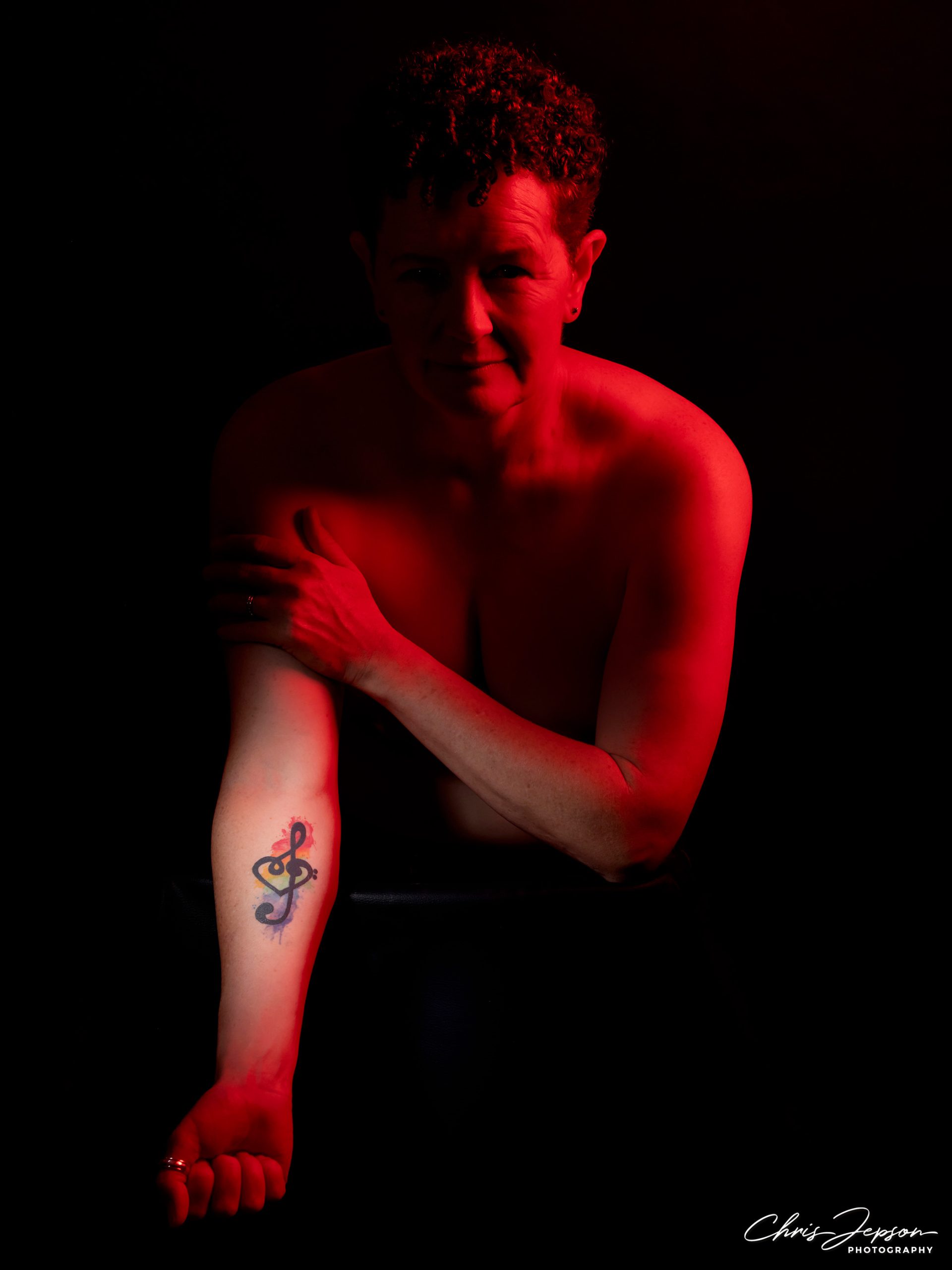

Emma
she/her
Emma made history as one of the first women to deploy at sea with the Royal Navy. Arrested and discharged in 1993 because of her sexual orientation, she challenged her dismissal at the European Court of Human Rights, contributing to a pivotal change in UK law in 2000. Her career since has spanned roles from file clerk and IT support to her current position as Programme and Operations Manager for the Global Privacy Office at RX Global.
Her work has been recognised with the Hero of the Year award at the British Diversity Awards 2024 and inclusion on the Diva Power List as both a role model in 2024 and Diversity Champion in 2025 and 2026. She serves as an independent panel member for the Ministry of Defence’s LGBT Veterans Financial Recognition Scheme.
Emma got her tattoo as a fiftieth birthday present to herself. At its simplest it represents her sexuality, her wife and her hobby, singing a cappella, shown through treble and bass clefs together, coloured in pride. More deeply, it marks her arrest, her case at the European Court of Human Rights, and her decision to live as a visible lesbian rather than hide, as she was once forced to.
She joined the Royal Navy at eighteen, when being gay in the military was illegal. About three and a half years later, she told a friend she thought she was gay. The next morning she was arrested, interrogated, had her belongings searched, and was later discharged, her career and identity dismantled for no reason beyond her sexuality. She describes having to rewrite her entire map of the world. Five years on, she found the strength to challenge the ban, taking her case to court and eventually the ECHR, contributing to the ban being lifted in January 2000.
The design was drawn by her wife, Fran, which makes it especially meaningful to her. She placed it on her forearm deliberately, visible to herself and not hidden from the world, a reminder of resilience and of the strength to do the right thing.
Body Language.
“For over thirty years, my work has centred on visibility, authorship and who gets to be seen.
This project continues my long-term commitment to photographing LGBTQIA+ lives.
For a lot of LGBTQ+ people, modifying the body is a way of marking a transition, standing in for something lost, or taking back a body that wasn’t always theirs to shape in the first place. That personal story is one I want to tell.”
Chris Jepson, photographer