

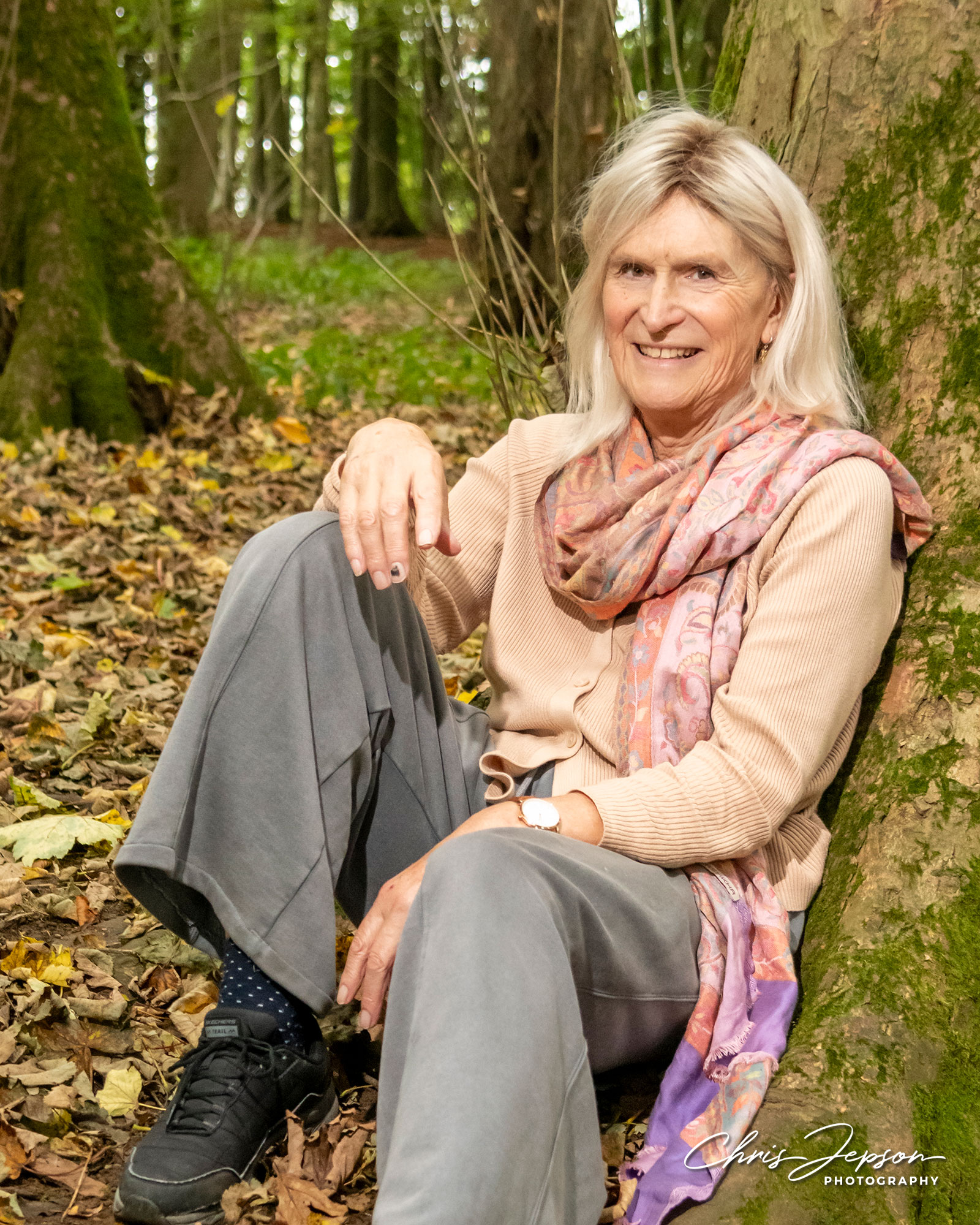
Photographed in Stranmer woods, Brighton,
Persia grew up in Liverpool in the 1950s, a femme child regularly beaten up by classmates who assumed he was gay – because trans, as she puts it, wasn’t even on the menu. School held nothing for her, so she left and started moving: Canada, Spain, Japan, California. In 1970, on a beach in Spain, she had what she describes as a profound spiritual realisation that has anchored her life ever since. She has meditated daily for 55 years.
She married, raised a son, lived for years in Tokyo, made money in the expat world, and carried the question of her identity largely alone. When the marriage ended in the early 1990s, she pressed the button. Transition came without the language or support structures that exist today. She arrived in Brighton around 1998 and found not a trans community – she’s clear that one doesn’t really exist in the way people imagine – but a queer world she felt she belonged in.
What followed was a decade of fire. She became a speaker, diversity trainer and activist at a time when LGB organisations were still debating whether to add the T. She gave talks to corporate lawyers, spoke at conferences across Europe, and helped set up the Metropolitan Police’s transgender staff group. In Hungary, with Morgan Stanley guaranteeing her security, she delivered the country’s first trans talk for business.
By the time Trans Pride Brighton launched in 2013, Persia had already done her major work and was happy to hand the baton on.
She lost her partner Janie a few years ago and says the grief took three years from her life. She has come through it and is now planning a podcast called We Are Far More Than Our Bodies – her argument being that the current political repression of trans people is built on the same ancient mechanism used against every marginalised group: reduce people to their bodies, then control the stories told about those bodies. She draws a direct line between her 55 years of meditation practice, the historian David Olusoga’s work on race and narrative, and what she sees happening to trans people right now.
At 77, she is not finished.
Queer Elders are the living record of LGBTQIA+ life.
This project continues my long-term commitment to photographing LGBTQIA+ lives.
For over thirty years, my work has centred on visibility, authorship and who gets to be seen.